A piano melting across a salt flat desert, a lighthouse of books floating in a nebula, a mechanical heart growing from an oak tree — these "impossible images" can now be generated in minutes with AI. But generating is just step one. The more important question is: where can this surreal visual style actually be used in real commercial scenarios?
This article doesn't discuss "how to generate better surreal images" — it focuses on 5 validated commercial applications and how to customize prompts for each.
Where This Effect Can Be Used (5 Real Scenarios)
Scenario 1: Brand Annual KV (Key Visual)
Need: A brand needs one "instantly memorable" hero image for year-round advertising, website hero sections, and launch event backgrounds.
Why surreal works: Traditional product photography makes people see "an object." Surreal visuals make people see "an idea." A watch floating in space ≠ a timepiece — it represents "transcending time." This leap from "product" to "concept" is exactly what brand KVs need.
Best for: Tech brands, luxury brands, avant-garde design brands, cultural institutions. Not ideal for FMCG (consumers need to see the actual product).
Scenario 2: Magazine Covers and Editorial Spreads
Need: A cover that "makes people stop and pick it up at the newsstand," or concept imagery for feature articles.
Why surreal works: A magazine cover's job is "capture attention in 3 seconds." Surreal images trigger the brain's "what is this?" response by violating everyday visual expectations — this reaction is faster than any headline.
Best for: Cultural commentary (New Yorker style), tech frontier (Wired style), art and design magazines. Not for news magazines (readers expect real imagery).
Scenario 3: TED Talks / Presentations / Exhibition Graphics
Need: A visual that "helps audiences understand abstract concepts." For example, a talk about "the nature of time" needs a supporting image.
Why surreal works: Surreal images fundamentally "turn abstract concepts into concrete visuals" — a melting piano = time passing, floating books = knowledge without boundaries. Visual metaphors are processed by the brain faster than text.
Best practice: Each image should carry one concept only — don't try to express 3 ideas in a single image.
Scenario 4: NFT / Digital Art Collectibles
Need: Artists need stylistically unique, highly recognizable digital art pieces that can form a series.
Why surreal works: Surreal style naturally satisfies three core NFT market demands — visual uniqueness (looks nothing like reality), emotional resonance (viewers generate personal interpretations), and series potential (different variations of the same theme).
Series strategy: Use one subject (e.g., "melting instruments"), change the environment (desert/ocean/space/forest), generate 4-8 pieces as a collection — unified theme + varied settings = collectible value.
Scenario 5: Game / Film Concept Design
Need: Games or films need "worldbuilding concept art" — visuals that help the team understand "what this fictional world looks like."
Why surreal works: Pre-production concept design requires massive "exploratory" visuals — not pixel-perfect but quickly conveying mood and direction. AI surreal images can generate dozens of directionally diverse concepts in minutes for team review.
Complete Prompt + Parameter Guide
Core Prompt Template
A high-impact surreal image featuring [SUBJECT] set
within an [IMPOSSIBLE ENVIRONMENT]. Dramatic lighting,
vivid imaginative colors, and sharp focus on
hyper-realistic details. The composition is
thought-provoking, exploring themes of [THEME]. Style:
High-end surrealist photography and digital art fusion,
high resolution, cinematic scale.
Three Adjustable Parameters
| Parameter | Function | Adjustment Range |
|---|---|---|
| [SUBJECT] | The core object in the image | From everyday objects (piano, book) to abstract concepts (time, memory) |
| [IMPOSSIBLE ENVIRONMENT] | The "impossible" space the object exists in | From natural extremes (deep sea, space) to conceptual spaces (digital matrix, dreamscape) |
| [THEME] | The theme the image conveys | From philosophical (time, existence) to emotional (loneliness, hope) to social (technology, nature) |
Critical rule: [SUBJECT] and [IMPOSSIBLE ENVIRONMENT] must create semantic conflict — a piano doesn't belong in a desert, books don't belong in space. No conflict = no surrealism.
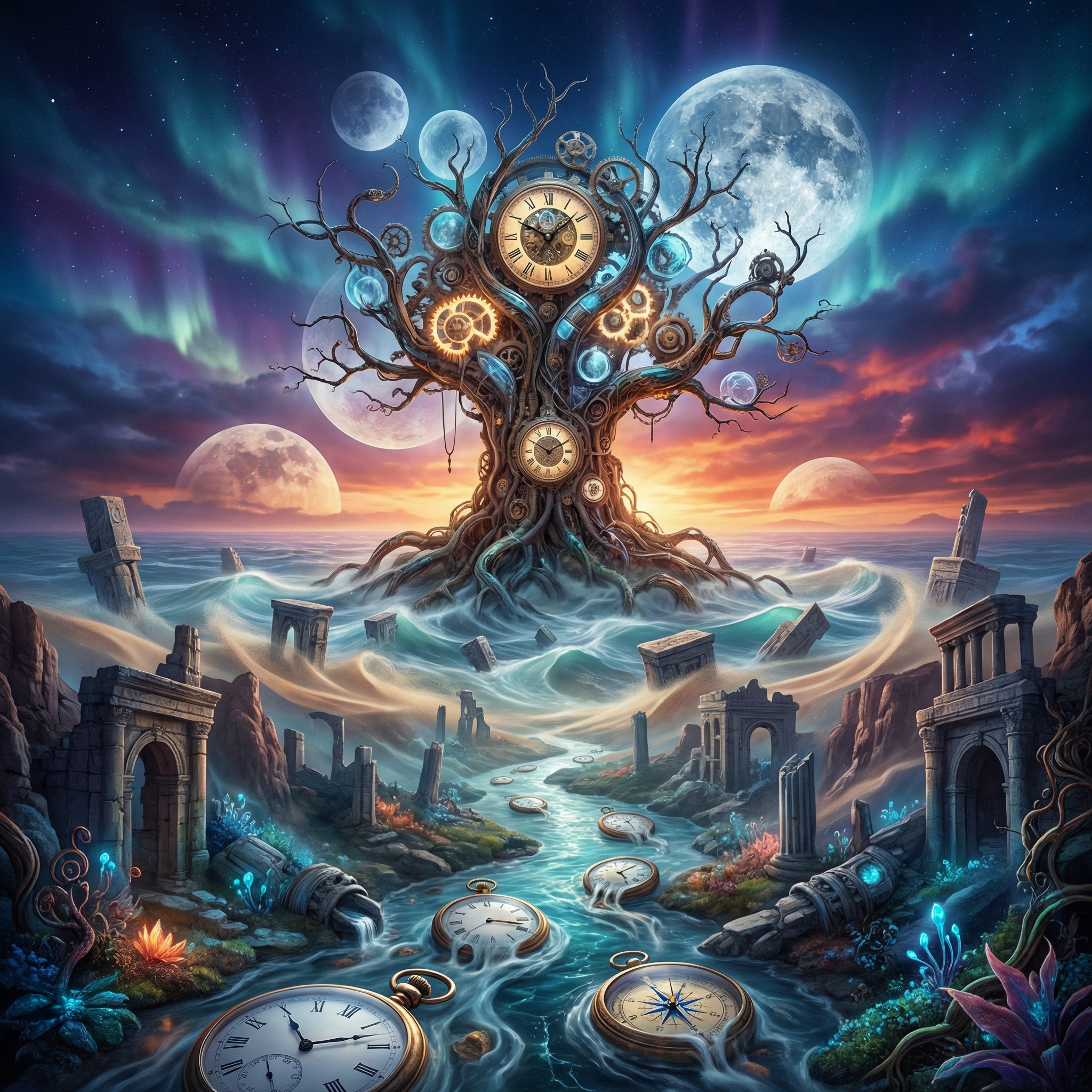
Scenario 1 Deep Dive: Brand KV — "Time Transcended"
Suppose the client is a luxury watch brand needing an annual KV conveying "time transcends physical existence."
Customized Prompt
A high-impact surreal image featuring a luxury
mechanical watch dissolving into golden sand particles,
set within an infinite desert of white salt flats under a
cosmic sky with visible galaxies. Dramatic side lighting
from the setting sun casting extremely long shadows. The
watch components — gears, springs, hands — are frozen
mid-dissolution, each piece suspended in air with
hyper-realistic metallic detail. The composition is
thought-provoking, exploring themes of time transcending
physical form. Style: High-end surrealist photography and
digital art fusion, 16:9 cinematic ratio, editorial
quality.
Customization Analysis
dissolving into golden sand particles: Not "placed in a desert" but "becoming sand" — from "object in environment" to "object and environment merging"components frozen mid-dissolution: Components frozen mid-disintegration — a pause in time metaphoring "time itself being paused"16:9 cinematic ratio: Brand KVs typically need widescreen — banner ads, website heroes, and launch event backdrops are all landscape formateditorial quality: Triggers AI to output magazine editorial-grade quality — more polished, more refined
Scenario 2 Deep Dive: Magazine Editorial — "The Weight of Civilization"
Suppose a magazine needs a feature image about "knowledge anxiety in the information overload era."
Customized Prompt
A high-impact surreal image featuring thousands of open
books forming a towering mountain peak, with pages
fluttering like bird wings at the summit, set within a
dark stormy ocean with massive waves crashing against the
book mountain's base. A single reading lamp glows at the
very top, casting warm light downward through the chaos.
Dramatic chiaroscuro lighting. The composition is
thought-provoking, exploring themes of knowledge
overwhelming the individual. Style: High-end surrealist
photography, vertical 3:4 magazine format, muted
desaturated palette except for the warm lamp glow.
Customization Analysis
thousands of open books forming a towering mountain: Books = knowledge, mountain = overwhelming quantity — the visual metaphor is immediately clearpages fluttering like bird wings: Pages flying like bird wings — knowledge yearning for freedom but trapped in the mountainsingle reading lamp: One lamp in a storm — metaphor for an individual seeking direction in an information floodvertical 3:4: Magazine pages are typically portrait orientationmuted palette except warm lamp: Only one warm light source — everything else is cold-toned, amplifying loneliness and anxiety
4 Golden Subject × Environment Pairings
| Subject | Impossible Environment | Theme | Best Application |
|---|---|---|---|
| Melting classical piano | White salt flats + cosmic sky | Time passing, beauty dissolving | Music brand KV, cultural editorial |
| Giant crystal tree | Inside a suspended water droplet | Life's fragility and grandeur | Environmental exhibition, science magazine cover |
| Shattered giant mirror | Floating above cloud layer | Self-awareness, identity fragmentation | Psychology talk slides, art NFT |
| Glowing mechanical heart | Growing from ancient tree roots | Technology merging with nature | Tech brand KV, TED talk slides |
Every pairing follows one core principle: the subject is "man-made/civilization's product," the environment is "nature/cosmos." A man-made object existing in nature is inherently surreal — because it "doesn't belong there."
Dramatic Lighting Control: 3 Intensity Levels
Surreal image lighting doesn't follow natural laws — it's deliberately designed as a "mood amplifier."
Level 1: Soft Dramatic (Best for Brand KV)
Soft dramatic lighting with gentle gradients, warm golden
hour side light, subtle shadows with soft edges
Effect: Directional but not extreme lighting — the image looks "premium" without being "unsettling." Suits commercial scenarios needing sophistication without being too avant-garde.
Level 2: Strong Contrast Dramatic (Best for Magazine/Exhibition)
Strong chiaroscuro lighting with deep blacks and bright
highlights, single directional light source creating
dramatic long shadows, high contrast
Effect: Deep blacks and bright whites in strong contrast — like Caravaggio paintings. Suits content needing "impact" within the bounds of "acceptable."
Level 3: Extreme Supernatural (Best for Art/NFT)
Multiple impossible light sources from below and within
objects, self-luminous elements floating in complete
darkness, rim light without visible source, neon color
bleeding
Effect: Light sources violate physics — objects glow on their own, light shoots from below ground, rim light appears without a source. Suits pure art contexts; use cautiously for commercial work.
Export and Post-Processing Recommendations
Export Specs by Scenario
| Scenario | Recommended Ratio | Recommended Size | Color Space |
|---|---|---|---|
| Brand KV (digital) | 16:9 | 3840×2160 | sRGB |
| Brand KV (print) | 16:9 | 5000×2812+ | Adobe RGB |
| Magazine cover | 3:4 portrait | 2400×3200 | Adobe RGB |
| Presentation slide | 16:9 | 1920×1080 | sRGB |
| NFT | 1:1 | 3000×3000 | sRGB |
| Game concept art | 21:9 | 3440×1440 | sRGB |
Post-Processing Tips
AI-generated surreal images typically need these adjustments:
- Local sharpening: Sharpen key subject details (gears, book pages, cracks) — AI sometimes renders details slightly soft
- Color unification: Check whether color temperature is consistent across the image — AI occasionally produces temperature shifts between different areas
- Shadow lift: Surreal images' dark areas usually need slight brightening — ensuring shadow details aren't lost in print
After generating the base image in nanobanana pro, final color and sharpness fine-tuning in Photoshop or Lightroom is recommended.
Interested in material control for "impossible objects" in AI? Our ghostly transparent form guide shows how to make AI render "physically impossible but visually credible" transparent material effects.
Cost and Efficiency Comparison (AI vs Traditional)
| Phase | Traditional | AI | Efficiency Gain |
|---|---|---|---|
| Concept exploration | Designer sketches 3-5 drafts (2-3 days) | AI generates 20-30 directional images (2-3 hours) | 10× |
| Hero visual finalization | 3D modeling + compositing + retouching (1-2 weeks) | AI generation + refinement + post (1-2 days) | 5-7× |
| Series variants | Re-model and composite each (3-5 days/piece) | Modify prompt and regenerate (30 min/piece) | 20× |
| Cost | Designer + 3D artist + retoucher ($2,000-7,000) | AI tools + post-processing ($70-280) | 10-25× |
Important limitation: AI-generated surreal images are well-suited for concept stages and digital media. For high-end print (large-format posters), using AI images as a base with professional designer final refinement and sizing is still recommended.
FAQ
Won't surreal images be "too weird" and damage the brand?
The key is controlling the degree of surrealism. Brand KVs using Level 1 soft dramatic lighting keep the subject recognizable while only the environment is surreal — this is an accepted aesthetic among premium brands (reference Apple's launch event background visuals). Full "nightmare-level surrealism" (Level 3) indeed isn't suited for mass-market brands, but works perfectly for avant-garde art and the NFT space.
How do I generate different style variants of the same theme?
Keep [SUBJECT] and [THEME] constant, only change [IMPOSSIBLE ENVIRONMENT] and lighting parameters. For example, "melting piano" theme: desert version (loneliness), underwater version (sinking), space version (eternity), forest version (return to nature). 4 environments × 3 lighting levels = 12 style variants.
Are there copyright risks with this style?
AI-generated surreal images don't inherently risk "copying a specific photographer" because the image content is physically non-existent. However, note: specifying "in the style of [specific artist]" in prompts may create style-level disputes. Use generic style descriptions (surrealist photography) rather than specific artist names.
Can generated images be used directly in commercial projects?
Technically yes, but these checks are recommended: 1) Confirm the AI tool's commercial use license terms; 2) Inspect whether the image accidentally generated recognizable trademarks or brand elements; 3) For premium commercial projects, add a round of human post-production refinement to ensure quality consistency.