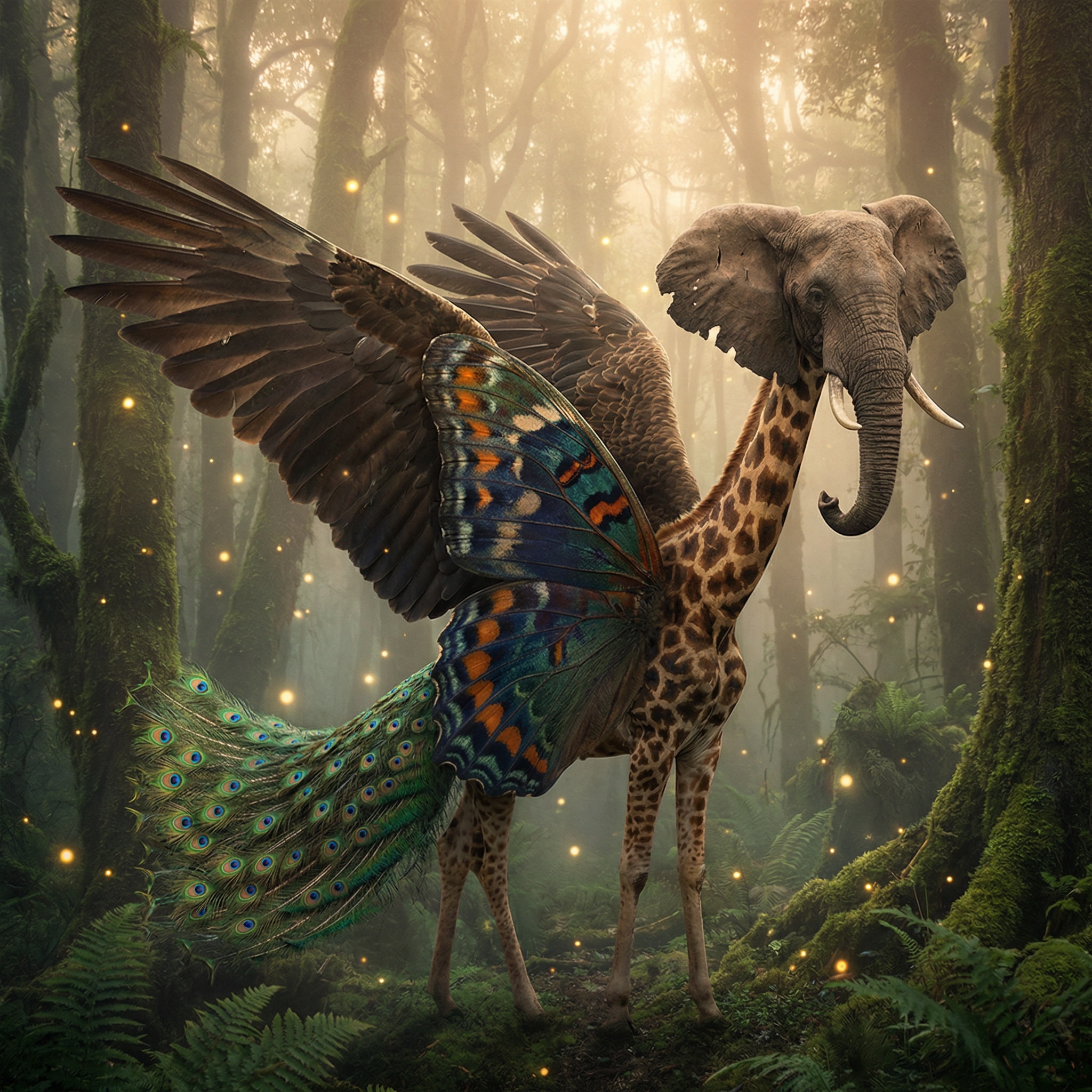
An elephant's head, a butterfly's body, a giraffe's neck, eagle wings, and a peacock tail — 5 animal features fused into a single organism. This kind of "cross-species chimera" is extremely common in AI concept design, but 90% of results look like "Photoshop collages" rather than "a creature that could actually exist."
The key isn't which animals you pick — it's how AI handles the transition zones between species. This article analyzes the fusion mechanics of this prompt from a technical perspective, and why certain species combinations are inherently more "credible" than others.
Technical Principle: How AI Understands "A Creature Made of Multiple Animals"
Multi-Species Prompt Parsing Order
When AI receives a prompt containing multiple animal features, it doesn't render all features simultaneously — it has an implicit priority system:
- Head first: AI establishes head morphology first, because the head determines the creature's "identity" — elephant head = this is an elephant-featured creature
- Body frame second: After the head, AI needs a body to "support" it — butterfly body defines the basic torso shape
- Connectors third: Neck, wings, and other connecting parts determine how pieces "grow together"
- Decorative features last: Tail feathers, patterns, and surface details render last
This means species features written earlier in the prompt receive greater visual weight. Placing elephant head at the beginning lets elephant genetics "dominate" the creature's overall character.
The Transition Zone Problem — Root Cause of "Seam Lines"
The most common problem when AI renders multi-species chimeras is abruptness at species boundaries. For example: the transition between an elephant's rough skin and a butterfly's scale-powdered wings.
Technical cause of abruptness: AI's training data contains no natural "elephant skin → butterfly wing" transition samples. When two non-overlapping material distributions are forced together, AI chooses between:
- Hard cut: Two materials change abruptly at the boundary — looks like a Photoshop mask
- Blended blur: AI blends both materials into an ambiguous color block at the boundary — looks like a rendering error
The solution is to actively manage transition zones in the prompt rather than letting AI handle them on its own.
Prompt Engineering: Weight, Order, and Combination Logic
The Complete Prompt
A highly detailed and surreal depiction of a mythical
bird creature. It has the elegant, colorful body of a
butterfly, with vibrant symmetrical wing patterns. Its
head is that of a majestic elephant, complete with large
ears, a long curling trunk, and ivory tusks, giving it a
powerful and ancient aura. A long, spotted giraffe neck
connects the body and the head, rising high with grace.
The wings are enormous eagle wings, fully extended with
dramatic feathers in motion. Its tail is an iridescent
peacock tail, fanned out in full display like royal
plumage. The creature stands in an enchanted misty
forest, bathed in ethereal light and surrounded by
glowing particles. Ultra-realistic, cinematic lighting,
fantasy atmosphere, hyper-detailed concept art.
Species Weight Distribution Table
The 5 animals in this prompt don't carry equal weight:
| Species | Body Part | Description Detail Count | Visual Weight | Role |
|---|---|---|---|---|
| Elephant | Head | 3 details (large ears + curling trunk + ivory tusks) | ★★★★★ | Identity core — determines "what this is" |
| Butterfly | Torso | 2 details (elegant colors + symmetrical patterns) | ★★★★ | Shape foundation — determines body silhouette |
| Eagle | Wings | 2 details (enormous + dramatic feathers in motion) | ★★★★ | Dynamic core — determines visual tension |
| Peacock | Tail | 2 details (iridescent + fanned display) | ★★★ | Decorative core — determines splendor |
| Giraffe | Neck | 1 detail (spotted pattern) | ★★ | Transition connector — physically links head to body |
Note: While the giraffe neck has the lowest weight, it's the most critical engineering component of the entire chimera — without it, the elephant's massive head sits directly on the butterfly's delicate body, causing proportional collapse.
Why Giraffe Neck as the Connector
A long, spotted giraffe neck connects the body and the head — the engineering value of this sentence:
- Proportional buffer: The massive elephant head and delicate butterfly body need a gradient transition zone. The giraffe's long neck provides exactly this natural thick-to-thin gradient
- Material bridge: Giraffe skin — spotted but overall smooth — is the intermediate material between elephant's rough skin and butterfly's smooth scale powder
connects the body and the head: This directly tells AI "this neck's function is to connect" — forcing AI to naturally blend three materials across the neck region
Without the giraffe neck, AI would likely generate an image of an elephant head "glued" directly onto a butterfly body — because there's no transition instruction.
Advanced Control: Pixel-Level Fine-Tuning
Control 1: Head Detail Density
The original prompt gives the elephant head 3 precise descriptions: large ears, a long curling trunk, and ivory tusks. Each locks in a recognition feature:
- Remove
large ears→ Head may render more compact, losing the elephant's signature "fan-shaped ears" - Remove
curling trunk→ Trunk may become short or straight — from "living elephant" to "elephant-shaped sculpture" - Remove
ivory tusks→ Loss of "ancient, powerful" implication — elephant shifts from "ancient sage" to "docile big ears"
giving it a powerful and ancient aura is critically important — it doesn't control shape, but controls how AI expresses elephant features: rougher skin, deeper colors, more profound eyes.
Control 2: Wing Dynamic Expression
in motion in fully extended with dramatic feathers in motion is an easily overlooked keyword.
Without in motion: Wings are statically spread — like a specimen museum display.
With in motion: Feathers have directional curvature — implying the wings are actively flapping or just finished flapping.
This detail transforms the chimera from "a posed model" to "a living, active creature."
Control 3: Environment's Impact on Fusion Credibility
enchanted misty forest isn't a random environment choice. Mist has a critically important technical function: blurring species boundaries.
In crystal-clear environments (white backgrounds, sunny meadows), AI must render sharp species transitions — which is exactly where "breaking of illusion" happens most. But in misty environments:
- Fog naturally obscures mid-body details — the transition from elephant neck to butterfly torso is partially "swallowed" by mist
ethereal lightmakes highlights across all materials converge — different materials under the same lighting look more unifiedglowing particlesdistract viewers from material boundaries
Boundary Testing: Where This Fusion Mechanism Breaks
Test 1: What Happens Beyond 5 Species
Expanding to 7 animals (adding "shark fins" and "chameleon skin"), AI starts selectively ignoring instructions — typically the last-mentioned features get dropped.
Tested upper limit: 4-5 species is the maximum AI can handle stably. Beyond 5, each additional species reduces the recognizability of an existing one.
Test 2: Physically Contradictory Combinations
Attempting combinations with physical contradictions — like "whale body + hummingbird wings":
- In theory: Hummingbird wings can't possibly support a whale's body
- AI's handling: AI doesn't calculate physics — it renders a whale-shaped body with relatively large hummingbird wings that are automatically scaled up to "look reasonable"
Conclusion: AI compromises physical accuracy for visual plausibility. This means you don't need to worry about "is this combination realistic" — just focus on "does this combination look good."
Test 3: Removing All Transition Descriptions
Strip out the giraffe neck and all transition language, leaving only a parts-list description:
A creature with elephant head, butterfly body, eagle
wings, peacock tail.
Result: AI generates a "collage-like" image — parts are recognizable but connections have visible "layer edge" artifacts. This proves transition descriptions aren't decoration — they're technical necessities for fusion.
4 Chimera Recipes
Recipe 1: Golden Stag Spirit
[HEAD] = golden stag with crystalline antlers catching light
[BODY] = swan body with pure white feathers
[WINGS] = dragon wings with translucent membrane
[NECK] = serpent neck with iridescent scales transitioning from white to gold
Effect: Elegant, divine, classical — the serpent neck's iridescent scales provide the perfect color transition from white swan body to golden antlers.
Recipe 2: Deep Sea Phantom
[HEAD] = anglerfish head with bioluminescent lure
[BODY] = jellyfish body with transparent bell
[WINGS] = manta ray wings with dark blue membrane
[TAIL] = deep sea eel tail fading into darkness
Effect: Dark, mysterious, oceanic — all species come from the sea, so material consistency is naturally high. The bioluminescent lure serves as the visual focal point.
Recipe 3: Mechanical Phoenix
[HEAD] = owl head with clockwork gears visible behind glass eyes
[BODY] = hummingbird body with metallic copper feathers
[WINGS] = mechanical wings made of interlocking brass plates
[TAIL] = phoenix tail of glowing molten copper streams
Effect: Steampunk × biological — all parts unified around "copper-toned metal" as the material base. The owl's clockwork eyes are the narrative core of "mechanical life."
Recipe 4: Aurora Spirit
[HEAD] = Arctic fox head with aurora-colored inner ears
[BODY] = snow leopard body with fur that shifts between white and pale blue
[WINGS] = snowy owl wings with frost crystals on feather tips
[TAIL] = nine flowing tails of pure aurora light, green and purple
Effect: Polar dreamscape — all species come from cold environments, and the unified white + blue + aurora palette makes the entire chimera "belong to the same world."
Test all 4 recipes in nanobanana pro to observe which species combination achieves the most natural fusion transition while maintaining recognizability.
Style Grafting Experiments
Graft 1: Chimera × Chinese Ink Wash
Add to quality words: rendered in traditional Chinese ink wash painting style, splattered ink effects, rice paper texture
Effect: From "realistic concept art" to "Chinese ink painting" — species details simplify, but artistic mood intensifies. The elephant head rendered in ink wash has especially powerful "impressionistic" force.
Graft 2: Chimera × Miniature Figurine
Add to environment: the creature is a detailed miniature figurine, only 5cm tall, sitting on a wooden desk, macro photography
Effect: From "real creature" to "collectible figurine" — same species combination but at miniature scale. Perfect for product showcase or collectible concept design.
Graft 3: Chimera × X-Ray Vision
Add to materials: the entire creature rendered as an X-ray scan, showing internal bone structure where different animal skeletons merge
Effect: From "surface fusion" to "skeletal fusion" — the X-ray perspective reveals how the elephant skull connects to giraffe cervical vertebrae. Transforms from "aesthetic artwork" to "anatomical fantasy."
Interested in cross-controlling biological forms and transparent materials in AI? Our ghostly transparent form guide shows how to use semi-rigid transparent material to give any form a "frozen liquid" quality.
FAQ
Why do some species combinations look more natural than others?
Visual credibility depends on two factors: 1) Material compatibility — fur-to-fur transitions are more natural than fur-to-shell (because AI training data contains abundant furry animal photos, so fur → fur transitions have more reference samples); 2) Body proportion compatibility — similarly-sized animals fuse more easily (elephant + rhinoceros is more natural than elephant + butterfly, because the size difference is smaller).
How do I make a chimera look like an "evolutionary product" rather than "artificial collage"?
Three methods: 1) Add as if it evolved naturally over millions of years, with cohesive biological logic; 2) Source all species from the same ecosystem (all marine or all arctic creatures) — environmental unity implies evolutionary unity; 3) Add a unified color mutation like all features share a bioluminescent blue-green tint.
Can this technique be used for non-biological fusions?
Absolutely. Species fusion logic applies to anything requiring "merging different things into one": architectural fusion (a building with Gothic cathedral top and Japanese temple base, connected by Art Deco middle section), vehicle fusion (a vehicle with submarine hull and helicopter rotors, connected by streamlined airplane fuselage). The key principle remains unchanged: transition zones require active management.
How do I handle "top-heavy" species combinations?
When the head species is much larger than the body species (like elephant head + butterfly body), three approaches: 1) Add a proportional buffer zone (like the giraffe neck); 2) Add proportionally scaled to maintain biological balance to the description; 3) Slightly enlarge the body — the butterfly body is enlarged to mythical proportions, matching the scale of the elephant head.