Place a perfume bottle on white marble, drape champagne silk as the base, surround it with peonies and lilies — this prompt generates magazine-grade product photography. But what happens to the "brand tone" when you swap silk for velvet, peonies for eucalyptus, or soft light for backlight?
This article runs cross-experiments on 3 independent variables to determine each parameter's real impact on the final image's "luxury tone."
Experiment Objective and Baseline Prompt
Baseline Prompt
A high-end editorial photo of an elegant perfume bottle
placed on a smooth white marble pedestal, resting on
flowing champagne-colored silk fabric. It is surrounded
by exquisite Peonies and Lilies in pastel tones whose
colors naturally harmonize with the product's primary
color scheme. Soft natural morning light from the upper
left, casting delicate long shadows. 3D technical
realism, professional luxury product photography, shallow
depth of field, 1:1 aspect ratio. Impeccable details.
3 Experiment Variables
| Variable | Baseline Value | Experiment Range |
|---|---|---|
| A: Base material | Champagne-colored silk | 4 materials compared |
| B: Floral palette strategy | Pastel tones harmonizing | 4 color strategies |
| C: Lighting angle | Soft natural morning light from upper left | 4 lighting setups |
Experiment rule: Change only 1 variable at a time while keeping others at baseline — ensuring differences come from that single variable.
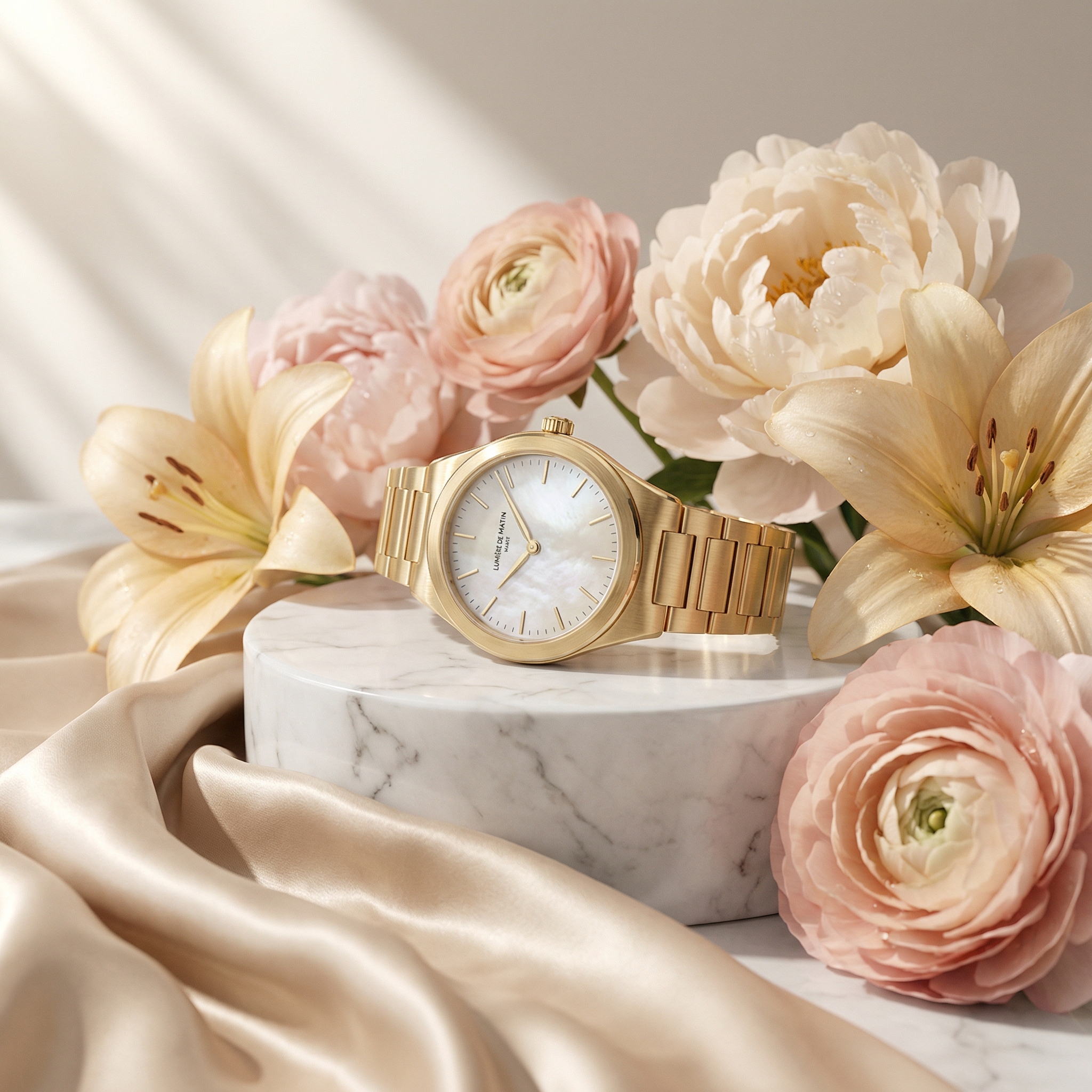
Variable A Experiment: 4 Base Material Results
A1: Champagne Silk (Baseline) — French Elegance
Baseline value. Silk characteristics: flowing folds, soft lustrous reflections, fine texture.
Visual tone: French romantic, feminine, airy. Silk's fluidity gives the image "breathing room" — like a moment being gently touched by wind. Best for perfume, jewelry, skincare.
A2: Dark Emerald Velvet — British Classical
Swap: resting on rich dark emerald velvet fabric with
deep, crushed texture
Velvet characteristics: heavy pile surface, deep light absorption, crush texture marks.
Visual tone: British classical, gender-neutral/masculine, weighty. Velvet absorbs rather than reflects light — the overall image darkens, making the product look like "a treasure emerging from darkness." Best for watches, whisky, leather goods.
Key difference: Silk is "platform display" (product in light), velvet is "treasure chest reveal" (product from shadow).
A3: Raw Linen — Japanese Wabi-Sabi
Swap: resting on natural undyed linen fabric with
visible weave texture and gentle wrinkles
Linen characteristics: rough weave texture, natural ecru tone, casual wrinkles.
Visual tone: Japanese wabi-sabi, organic natural, understated. Linen redefines "luxury" from "refined" to "authentic" — the product looks like it's on a designer's studio table rather than in a department store window. Best for organic skincare, handmade jewelry, tea sets.
Key difference: Silk says "this is expensive," linen says "this is real."
A4: Glossy Black Lacquer — Modern Minimalist
Swap: placed on a glossy black lacquer surface with
mirror-like reflection of the product visible below
Black lacquer characteristics: mirror reflection, pure black base, zero texture.
Visual tone: Modern tech, minimalist, cold. The black mirror surface creates a product reflection — from "one product in a scene" to "a product and its double." Best for tech products, premium headphones, concept designs.
Key difference: Silk creates "warmth," black lacquer creates "distance."
Variable B Experiment: 4 Floral Palette Results
B1: Pastel Harmonizing (Baseline) — Tonal Unity
Baseline value. Flower colors stay within the product's color family — pink perfume with pink peonies.
Visual tone: Harmonious, unified, non-confrontational. The image looks like a carefully mixed watercolor — all colors in the "safe zone." Advantage: strong sophistication. Disadvantage: may feel slightly "flat."
B2: Complementary Bold — Color Conflict
Swap: surrounded by deep burgundy dahlias and vibrant
orange marigolds that create bold color contrast against
the product
Contrast strategy: product is cool-toned (silver/blue/white), flowers are warm (burgundy/orange/gold).
Visual tone: Dramatic, passionate, visually arresting. Complementary colors create "tension" between product and flowers — the image shifts from "quiet" to "intense." Ideal for social media images that need to "pop" in feeds.
Key difference: Harmonizing is "an elegant whisper," complementary is "a confident statement."
B3: Neutral Greenery — Gender-Neutral Modern
Swap: surrounded by eucalyptus branches, dried ferns,
and white baby's breath in muted sage green tones
Replace colorful flowers with green foliage and white small flowers.
Visual tone: Nordic minimalist, gender-neutral, modern. Green plants shift the tone from "romantic" to "modern lifestyle" — suitable for brands targeting universal markets. Eucalyptus and dried ferns also imply "sustainable" and "organic" values.
Key difference: Colorful flowers say "romance," greenery says "lifestyle."
B4: Monochrome White — Ceremonial Purity
Swap: surrounded by all-white flowers only — white
roses, white orchids, and white lily of the valley —
creating a monochromatic elegance
All flowers unified as white.
Visual tone: Bridal purity, ultimate sophistication, ceremonial. White flowers make the image approach "sacred" — the product becomes the only "color anchor" in a pure white world. Best for product launches, limited editions, wedding/holiday gifts.
Key difference: Colorful flowers split attention (flowers compete with product), white flowers yield attention (flowers are background, product is sole protagonist).
Variable C Experiment: 4 Lighting Angle Results
C1: Upper Left Soft Natural (Baseline) — Magazine Standard
Baseline value. Light enters from upper-left at 45° — simulating floor-to-ceiling window natural light.
Visual tone: Standard editorial light, warm, natural. This is the most common lighting position in magazine product photography — safe, professional, reliable. Shadows fall to the lower right, creating natural dimensionality.
C2: Flat Frontal Diffused — E-Commerce Clean
Swap: flat, even, frontal diffused light with minimal
shadows, as if shot in a professional light box
Light hits evenly from the front, nearly shadowless.
Visual tone: E-commerce standard, clean, emotionless. Frontal light eliminates all shadows — the image is extremely "clean" but also extremely "flat." Ideal for e-commerce white-background shots and product catalogs.
Key difference: Side light creates "story" (shadows give direction), frontal light creates "information" (no shadows = no mood).
C3: Dramatic Backlight — Cinematic Mystery
Swap: strong backlight from behind the product, creating
a glowing halo effect around the bottle silhouette,
flowers in semi-silhouette
Light comes from behind the product — product and flowers become silhouettes/semi-silhouettes.
Visual tone: Mysterious, premium, cinematic. Backlight creates a halo effect around product edges — transparent materials (glass bottles) reveal internal liquid color under backlight. Best for perfume, spirits, and other transparent-container products.
Key difference: Frontal light shows "what the product looks like," backlight shows "the product's soul."
C4: Hard Side Light — Avant-Garde Bold
Swap: sharp, directional side light from the right,
creating deep defined shadows and strong highlight
contrast on the marble surface
Light hits from the direct side — sharp shadow edges, extreme contrast.
Visual tone: Avant-garde, bold, architectural. Hard light makes marble texture become extremely dimensional — from "soft pedestal" to "weighted stage." Suits modern design brands and architectural firm brand visuals.
Key difference: Soft light says "I'm beautiful," hard light says "look at me clearly."
Cross-Comparison: Optimal Combinations
| Brand Type | Best Material | Best Floral Strategy | Best Lighting | Combined Effect |
|---|---|---|---|---|
| French perfume/skincare | Champagne silk | Pastel harmonizing | Upper left natural | Textbook French elegance |
| British watches/leather | Emerald velvet | Monochrome white | Hard side light | Classical gentleman's treasure |
| Japanese organic skincare | Raw linen | Neutral greenery | Flat frontal | Wabi-sabi purity |
| Tech digital products | Black lacquer | Neutral greenery | Dramatic backlight | Futuristic tech aesthetic |
| Wedding limited gifts | Champagne silk | Monochrome white | Upper left natural | Sacred ceremonial purity |
| Avant-garde design brand | Black lacquer | Complementary bold | Hard side light | Bold avant-garde conflict |
Parameter Quick Reference
Base Material:
  champagne silk     → French elegance, feminine, flowing
  emerald velvet     → British classical, neutral/masculine, weighty
  raw linen          → Wabi-sabi aesthetic, organic natural, understated
  black lacquer      → Modern tech, minimalist cold, mirror reflection

Floral Palette:
  pastel harmonizing → Harmonious unified, premium safe
  complementary bold → Dramatic impact, social media punch
  neutral greenery   → Gender-neutral, lifestyle modern
  monochrome white   → Ultimate purity, ceremonial focus

Lighting Angle:
  upper left soft    → Magazine standard, warm natural
  flat frontal       → E-commerce clean, emotionless
  dramatic backlight → Mysterious premium, transparent materials
  hard side light    → Avant-garde bold, architectural texture
Test different combinations with the same product in nanobanana pro to find the parameter set that best matches your brand tone.
Unexpected Discoveries
Discovery 1: Velvet + Backlight = Glowing Pile
When dark velvet meets backlight, the pile edges produce a subtle "micro-glow" effect — light scattering through velvet fiber tips creates a soft diffusion. This doesn't happen with silk because silk's surface is too smooth.
Discovery 2: Linen + Complementary Flowers = Bohemian Luxury
We expected linen + bold colors to look "cheap," but the actual effect is "bohemian luxury" — like the most expensive booth at a craft market. This combination is perfect for artisan brands.
Discovery 3: Black Lacquer + White Flowers = Yin-Yang Aesthetic
Black surface + white flowers produces an extremely powerful black-and-white contrast — the reflection of white flowers in the black mirror creates a visual effect reminiscent of yin-yang patterns. A completely unexpected aesthetic surprise.
Interested in material rendering control in AI product photography? Our landmark furniture design guide shows how to use material transformation parameters for natural transitions between different materials.
FAQ
Is this style only for luxury products?
No. The core principles (material contrast + color harmony + lighting control) apply to any product. Everyday products work too — a handmade soap on linen with greenery and soft light produces the same "curated lifestyle" feel. The difference isn't product price — it's how thoughtfully the scene is built.
How do I handle reflective products (metal/glass) vs matte products differently?
Reflective products need diffused soft light (C1 or C2) — avoiding overly bright specular highlights that mask product details. Matte products can handle stronger directional light (C3 or C4) — side light enhances matte material texture. Add controlling specular highlights on reflective surfaces or emphasizing matte texture details with directional light to your prompt.
What besides flowers can serve as accent elements?
Flowers are the "safest" choice, but alternatives abound: fruit (lemon slices + rosemary = Mediterranean freshness), fabric accessories (ribbons + lace = gift feeling), natural elements (shells + sand = vacation feeling), stationery (fountain pen + wax seal = correspondence feeling). Selection criteria: accent elements' material and color must form meaningful association with the product, not random decoration.
Is 1:1 square always the best aspect ratio?
1:1 is optimal for social media and e-commerce (Instagram, Xiaohongshu, Taobao hero images are all square). But different platforms have different optimal ratios: brand website hero sections use 16:9 landscape, Xiaohongshu posts use 3:4 portrait, Pinterest uses 2:3 portrait. Control this in your prompt with [ratio] aspect ratio.